
Our daily routines and educational practice are rooted in the twin values of Dignity and Respect.

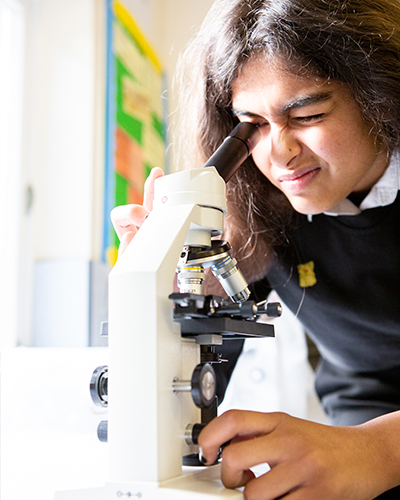
Our Science curriculum is designed to inspire curiosity and equip students with the knowledge and skills to thrive. Built on three key principles—relationships, routines, and ratio—we create a supportive and structured environment where every learner can succeed. Strong teacher-student relationships foster engagement and growth, while clear routines ensure progression from concrete experiences to abstract concepts. Our ratio-based approach enables high student participation and cognitive engagement, balancing breadth across Biology, Chemistry and Physics with depth in key ideas, helping students make meaningful connections and develop critical thinking. Inclusivity is central to our vision: we provide targeted support for disadvantaged and SEND students, ensuring Science is accessible to all. Through research-informed practice and collaborative teaching, we deliver a curriculum that promotes curiosity, resilience, and achievement—preparing students to live life in all its fullness and contribute positively to society.
Dr Dan WestSubject Leader for Science / Science Teacher (Physics) / Data Manager |
Mrs Anna EwartScience Teacher (Chemistry) / AHT Personal Development and Inclusion |
Mrs Emma LairdSecond in Science / Science Teacher (Biology) |
Mr Colin ArblasterScience Teacher (Physics) / School RPS |
Mrs Sarah BrockwellScience Teacher (Biology) |
Ms Denise HarrisonScience Teacher (Chemestry) |
Mrs Kirsty ConnellScience Teacher (Chemistry) / Assistant SENDCo |
Mrs Vicki HullScience Teacher (Biology) |
Miss Ella HopkinsScience Technician |
Miss Janice AtackScience Technician |
Mrs Alice RidgwaySecond in Science |
Mr Jeremy SampsonScience Teacher (Biology) |
Miss Francesca ParkerSecond in Science / Science Teacher (Biology) |
Miss Jade ClarkeSecond in Science) |
Mr Tim EwartSenior Science Technician / Assistant Manager Duke of Edinburgh |
Our intent at KS3 is to introduce students to the key ideas, knowledge and concepts in Science. This gives students a “first glance” at the GCSE topics, embedding review and reflection into their secondary Science curriculum. In this way, students can be stretched and introduced to GCSE concepts, whilst reviewing and embedding ideas and knowledge that they are taught at KS2. The role of the KS3 Science curriculum is also to promote “awe and wonder”; we ensure that many links are made to everyday life in order to make learning relevant and interesting for all. Ethics and morality in Science issues are also introduced through debates and persuasive writing. To further increase the role of Science within the wider school curriculum, students are taken to Whipsnade Zoo, where they undertake an investigation linked to the Environment and Ecosystems unit of work. Key maths, practical and investigative skills are introduced throughout the units, ensuring students have the foundation needed at KS4. This is particularly important with the focus of required practicals in KS4 and 5, and the increase in both quantity and demand of maths questions within Science exam papers.
In March of Year 8, students choose their route through GCSE, to sit either the GCSE Combined Science (Trilogy) or Separate Science courses, both of which have strong proven routes into A Level. They are supported in this decision by their teachers using Science assessment data, maths data and projected FFT20 estimates to inform this decision. Uptake to Separate Science has been sustained over the past years with classes of 30 operating. This curriculum flexibility allows for students who are most interested in Science to spend extra time increasing both their breadth and depth of understanding from Year 9.
In Year 9, whichever pathway is selected, all students are re-introduced to key concepts, knowledge and ideas in Science, and these are consolidated. Year 9 is a year during which students are taught techniques to increase their depth and breadth of understanding, enabling them to know more and remember more. At the end of each topic students are introduced to different revision techniques, and are explicitly taught the 5 steps to successful revision. This is modelled with students, teaching them, for instance, how to condense notes as a mind map, revision cards and revision notes, enabling them to settle on their preferred method at KS4. This work encourages students to become independent learners and means they understand how to learn the content. In addition to this, Year 9 is a year when we introduce many of the practical and maths skills which will become core to their understanding at KS4. During the Biology Cells topic, they are taught conversion of units and rearranging equations. In Chemistry, during the Atomic Structure unit, they are taught the main separation techniques and the laboratory equipment used for this in order to increase their practical competency and begin to develop the skills to become independent in the lab. Through the Chemical Change topic, students are taught key skills with equations, balancing, constructing formula, ionic equations and half equations. In Physics they are introduced to Energy Stores and Pathways and how to use this terminology, which will then be applied across their GCSE. The “awe and wonder” of science is promoted through an independent research project that students complete after returning from visiting the Science Museum in London. This allows students to research an aspect of science that interests them and present it to the class, encouraging students to think like a scientist; and back up their ideas with sound scientific knowledge.
In Years 10 and 11 we have carefully mapped the key topics to ensure progression both within and between the three disciplines. The KS4 curriculum delves deeper into ideas that have been introduced at KS3, allowing for a review of previous knowledge before deepening this, in many cases with the “why”. The order of the curriculum allows ideas that were introduced in Year 9 to be met and consolidated again in Years 10 and 11. There is a large focus on practical work and the use of this to support students’ critical thinking and understanding of science concepts. As a department, we carry out many more than the 21 required practicals. This ensures students have a deep and solid understanding of investigative skills, working towards the Working Scientifically part of the specification. The department has a bank of exam questions to use in conjunction with this. Likewise, maths skills are built into the curriculum to ensure students revisit the skills highlighted in the maths requirement section of the specification.
Our aim at KS5 is to provide rigorous and academic qualifications which enable the largest number of students to continue their study of Science. In addition to Biology, Chemistry and Physics we also run a level 3 Applied Science course. In this course, students focus more on investigative skills and the application of science in the community. Students are encouraged to think critically, evaluate knowledge that has been presented to them and present their own ideas and findings in appropriate formats. This specially designed course links to applied routes such as Forensics or Medical Physics.
Students are introduced to KS5 with a transition period, during which the required key skills are introduced. Moving on to the specifications, students visit topics mapped to allow for progression. Students develop a knowledge and understanding that allows them to explain concepts in greater depth and explain complex scientific ideas. As with previous key stages, we focus again on skills, with practical skills being embedded across our curriculums and many more than the required number of practicals being carried out. This means that students develop into sound scientists, able to carry out the variety of techniques from the specification. The Science department are fully dedicated to promoting students’ study skills. Students have a “bible” where they write up condensed notes for each unit which, along with practice questions, is handed in to staff at the end of unit test for that topic. They also have a list of advisable independent work. This, alongside the practical focus, ensures that students have the independent study skills necessary to succeed with further science education.
Students are taught the following topics in Year 7:
Biology:
Chemistry:
Physics:
Investigation Skills in KS3:
Year 8 Overview
Students are taught the following topics in Year 8:
Biology
Chemistry
Physics
Investigation Skills in KS3:
Suggest improvements to their investigations
Students are taught the following topics in Years 9 to 11:
AQA GCSE Biology and AQA Combined Science Trilogy Biology content
AQA GCSE Chemistry and AQA Combined Science Trilogy Chemistry content
AQA GCSE Physics and AQA Combined Science Trilogy Physics content
Students are taught the following topics in Year 12 and 13:
AQA A Level Biology
AQA A Level Chemistry
Physical Chemistry:
Inorganic Chemistry:
Organic Chemistry
AQA A Level Physics

Waddesdon Church of England School’s Assessment and Feedback Policy. At Waddesdon our aim is for assessment to be: